
 Leigh-Anne Harber
Table of Contents
ToggleLiving in the Foothills of the Lowveld means we are not just landowners with a home and a garden; we are the custodians of a piece of land that is home to countless indigenous plants, trees, birds, and wildlife.
Except for maybe 6 hectares, the land included in our property is untouched.
The deeper one walks into the bush, the more evident it is that this is a piece of paradise, full of all sorts of interesting plants, including some rare finds.
Sitting some 900 meters above sea level, we are in the mountains between Barberton and Nelspruit, an area known as the Foothills. It is a region that is not quite Escarpment but also not quite typical Lowveld, a fascinating in-between place where mornings are often misty, days hot and humid, and evenings quite cool.
To understand the plants and how they adapt to the seasons, and to have an ongoing record, I plan to catalogue as many of the wildflowers and trees as I can. Here you will find my personal notes on the plants I find as well as a variety of high-quality images. Please feel free to leave a comment below if you have any interesting information about the plants I catalogue here, or if you have a correction on plant names.
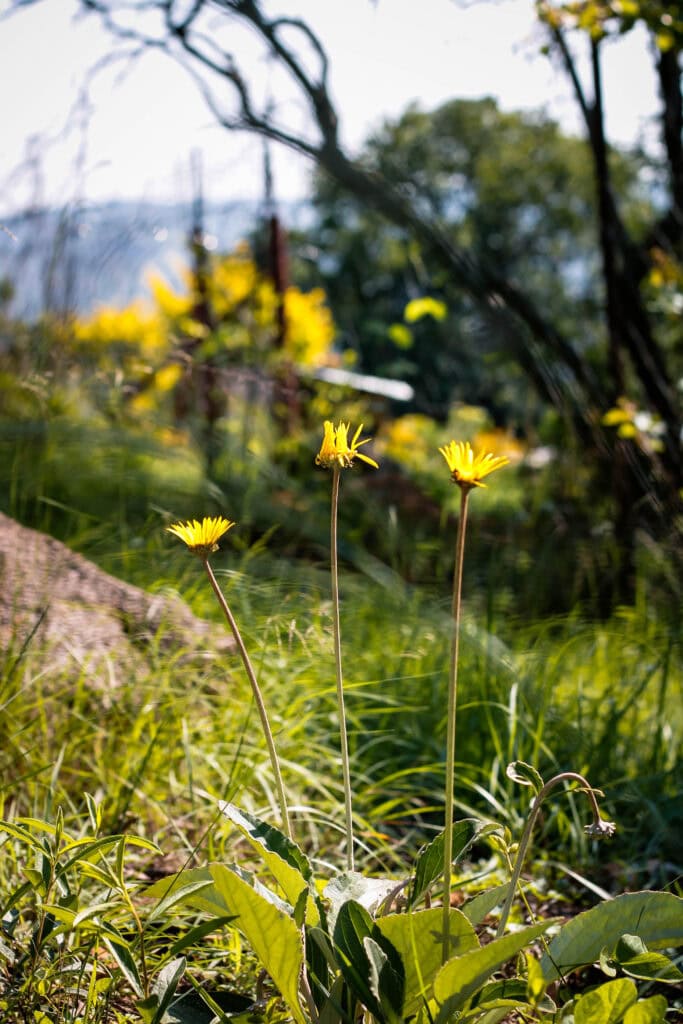
Tontelbossie (Haplocarpha scaposa)
When I first saw these blooms, I was quite convinced that it was a Barberton Daisy. But then I took a closer look and saw that while there are similarities, they are not the same.
This bloom is scattered all over the area and it flowers from August to December. It is quite common in medium to high altitudes and seems to prefer grassland.

Bloupoeierkwassie (Cyanotis speciosa)
The name of this one is absolutely not PC, so I will refrain from writing its more common name. (And its scientific name has me thinking about Mad Max.)
Its stunning dark blue, almost purple, flowers stand out beautifully against the new green summer grass. It fits in perfectly and if you don’t watch where you are walking, you’ll step on it.
The plant grows low to the ground and it also prefers grasslands in medium to high altitudes.

Gloriosa superba (Yellow Flame Lily)
An unusual-looking plant, the Yellow Flame Lily is hard to miss, even in the overgrown summer bushveld. This plant is a climber, so you’ll spot it clinging onto its neighbouring plants, growing up to 4 meters tall!
The plant has a tuber and lays dormant until the spring, when it puts on green shoots. It flowers from November to March and comes in shades of orange and, in this case, pure yellow. The flowers are “nodding”, which means they hang upside down with the petals bent backwards.
The plant is widespread in the Lowveld and incredibly poisonous (if eaten, it can kill).

Gladiolus Dalenii
One of the wildflowers that made me jump for joy, this particular variety of Gladiolus (the Lowveld has many) stands out from the rest of the bush because of its magnificent colouring!
Gladiolus are a popular garden plant, although the variety that you would usually buy from a supplier is not actually an indigenous plant, but one that has been hybridised from this native species.

Gladiolus hollandii
Walking through the bush after an intense week of rainfall, on a January afternoon, I spotted an abundance of these gorgeous blooms.
Gladiolus hollandii is similar in appearance to Gladiolus ecklonii, only the holandii variety has maroon streaks, while ecklonii has more speckles.
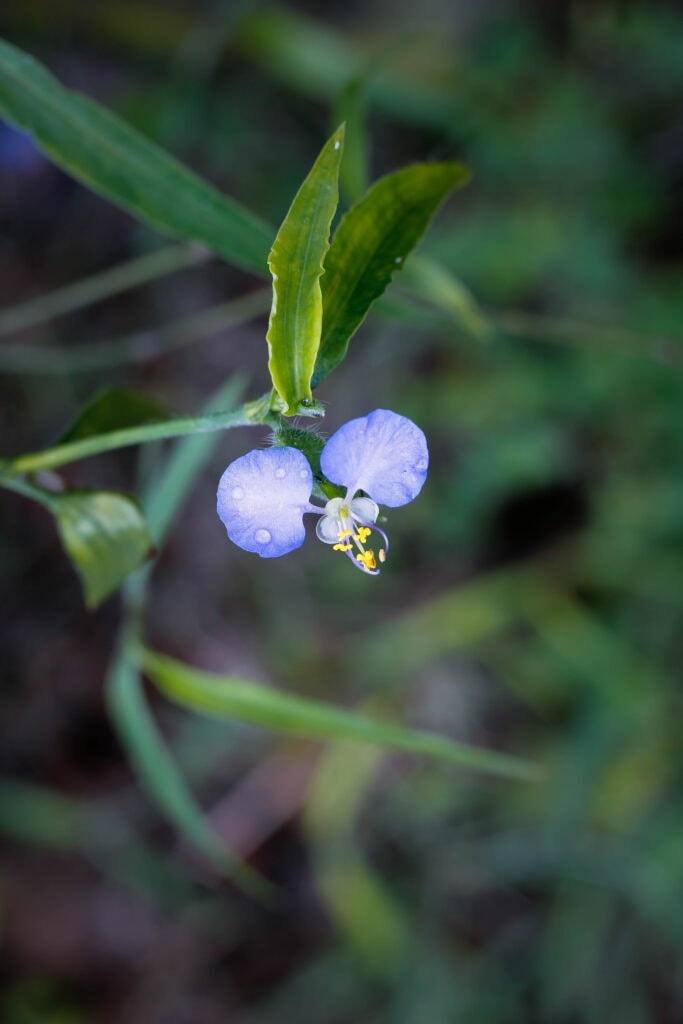
Blouselblommetjie (Commelina modesta)
I have always thought this was just another weed, but how wrong I was.
Blouselblommtjie is a native perennial, with long stems which in the early mornings are covered with these eye catching blue flowers.
They bloom from the end of September, through to the end of summer, and can be found in wooded grasslands.

Sausage Tree (Kigelia pinnata)
This one might need no introduction. In August, through to the end of September, when the new leaves start appearing, so too do the striking maroon flowers of the Sausage Tree.
During the day, the flowers are visited by sunbirds while in the evenings, bats enjoy the nectar. The flowers have quite the interesting scent!

African Potato (Hypoxis hemerocallidea)
African Potatoes grow wild in various parts of South Africa, including the Lowveld. They have the look of a lily but the flower, which is yellow, is quite smaller than your average lily.
These plants thrive in open grassland as well as woodland.
Although it is called a potato, it actually makes corms, and these corms are used treat infections, cancers, and TB.
They are difficult to grow from seed, but are stimulated by natural bush fires, which happen often out here.

Sesamum trilobum (Wild Foxglove)
Resembling a European Foxglove, but with far fewer blooms per stem, the Wild Foxglove is a beautiful flower that is hard to miss when you’re walking through the bush. It grows up to 2 meters and has pink or mauve flowers, with dark pink stripes on the inside.
The plant is extremely common, you’ll more than likely have seen it growing along the roadside somewhere. When the plant flowers, it is a favourite for honey and carpenter bees, so be careful if you intend to pick it.
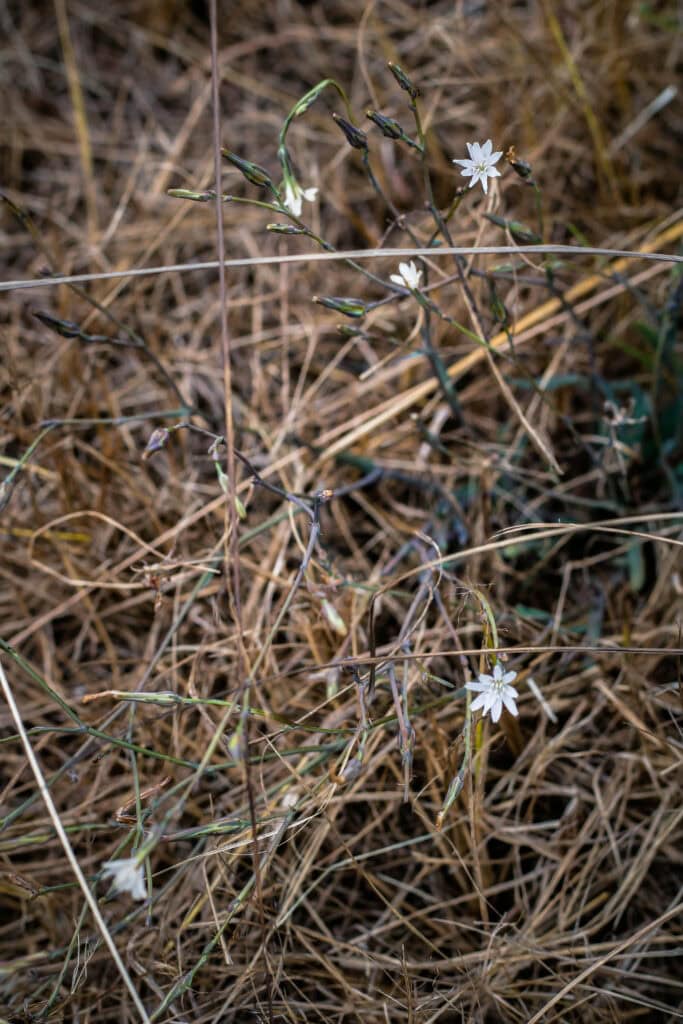
Lactuca Inermis Forssk
A dainty pioneer plant that is often found in areas that have recently been disturbed, lactuca inermis forssk, also known as Iklabeklabe, can be found all over the country.
It is a rather woody plant, with individual stems, and at the tips of the stems, there is the smallest white flower.
I have seen this plant in both winter and summer, although it really stands out in winter, when the grass around it has died back.

Launaea Rarifolia var. Rarifolia
This one was hard to identify. I am still not 100% sure I have the right name for it. I can only find one other example of it.
Launaea rarifolia var. rarifolia, is a low growing plant with the most eye catching purple flowers. It seems to flower towards the end of winter, in medium altitude grasslands.

Crossandra (Crossandra greenstockii)
This beautiful flower blooms low to the ground from around the end of October to December. In the otherwise green summer bushveld, the orange flowers of the Crossandra, stand out.
Through the lifespan of the blooms they seem to get darker and the flower buds open up along the stalk.
These flowers can be found in woody and rocky grasslands, all over the Lowveld.

Becium obovatum var. galpinii (Ocimum obovatum)
This one might look like a weed but it is actually a perfect addition to a summer time, water wise garden.
Becium obovatum var. galpinii (Ocimum obovatum), is one of 33 currently known species and it was given its old name Becium because it resembles sage.
It has various medicinal uses in Africa, including being a remedy for hair loss and it can be used as an enema.
The plants are suitable for areas that regularly burn, like the Lowveld. It flowers between August and November, in open or slightly wooded grassland.

Chimunamato (Acalypha peduncularis)
Walking in the veld, you would likely step on this flower if you weren’t paying attention.
The plant has stems that only grow to about 300mm and the tiny flowers differ depending on whether you are looking at the male or female plant.
Males have these tiny red buds that open up to a white inner while the female is fluffy. The result is that these flowers are often mistaken for being from two different types of flowers.
Chimunamato flowers between February and September and can be found in high altitude grasslands.

Sedge (Cyperus obtuisflorus var obtuisflorus)
Sedge, also known as Wituintjie or Biesie, grows to 600mm and has tiny but beautiful white spikes that are tightly packed together, topped with teeny yellow flowers.
It blooms all over the Lowveld, between October and February.
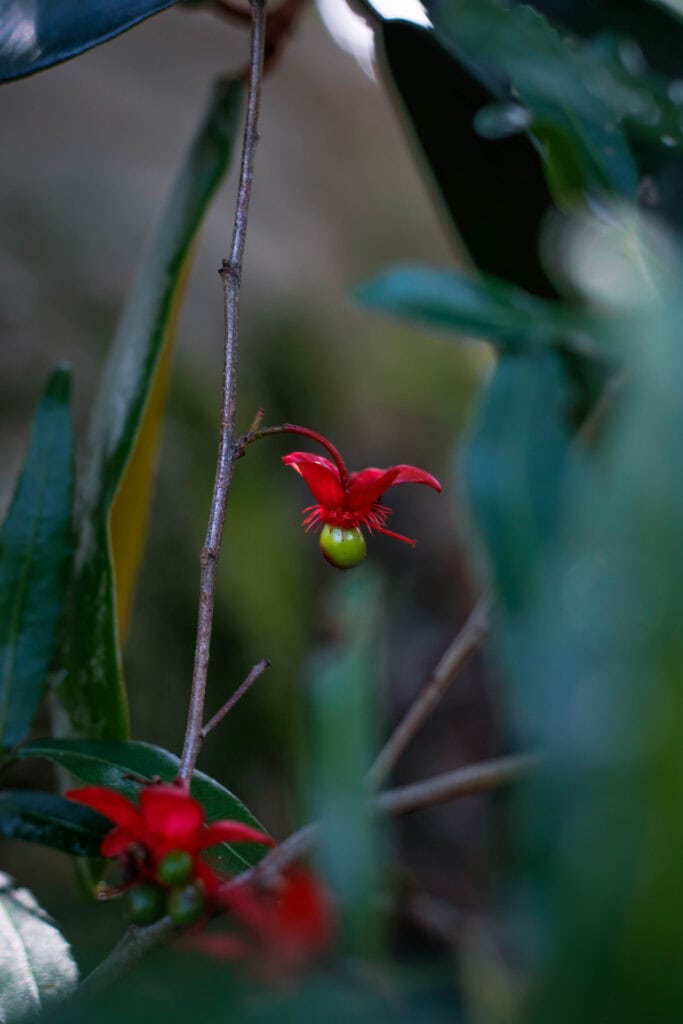
Mickey Mouse Bush (O. natalitia)
A red flower that stands out in the green bush, I couldn’t believe that this plant is indigenous.
O. natalitia, or Mickey Mouse Bush has bright yellow flowers from around August to December and grows to 1 to 3 meters high. After flowering, the plant develops little green fruits that eventually turn red, making it look like the beloved Disney character.
It can usually be found on rocky outcrops all over the area.

Wild Verbena (Pentanisia prunelloides)
A perennial that can have either a single stem or multiple ones, Wild Verbena is a beautiful thing to come across in the veld. Instead of one big old flower, the verbena makes multiple little blossoms, growing densely together.

Linderniella nana
A tiny, low-growing perennial, Linderniella nana is native to Southern Africa but not endemic to South Africa. The plant tends to grow in shallow moist soil, on rock.
The flowers are pink/purple and white, with a yellow centre, with the plant itself growing no more than about 5 cm in height. The plant has a spreading nature.
Linderniella nana and Linderniella whimsii look almost exactly the same but for the leaves, of which the nana variety has spiked leaves.
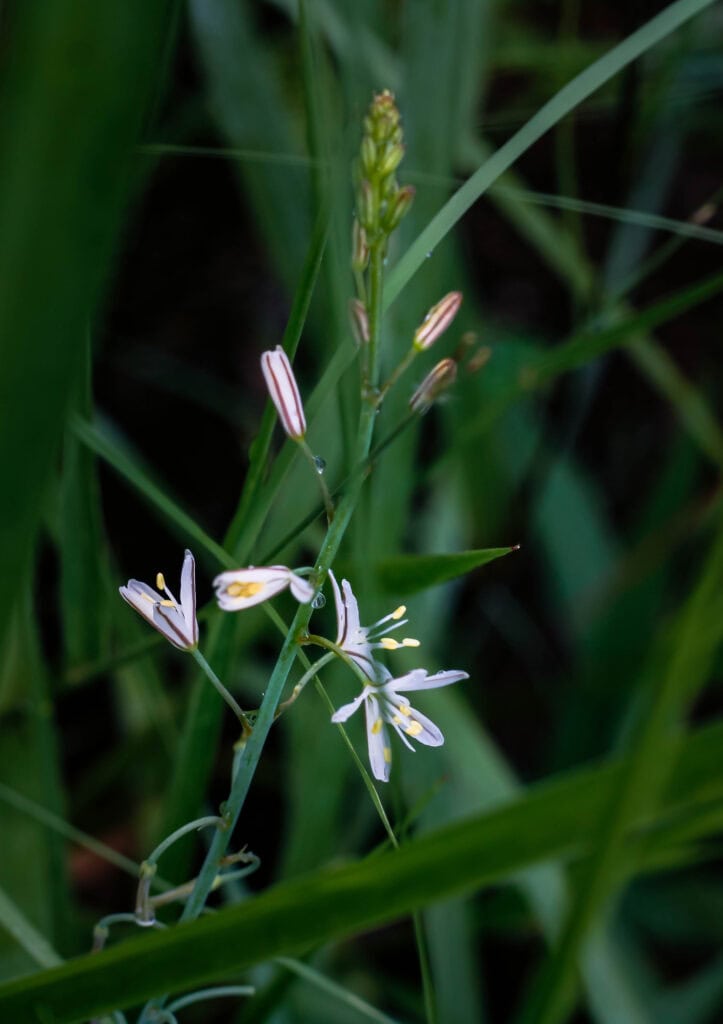
Trachyandra saltii (Wildeknoflok)
A succulent perennial that grows up to 50cm in height and has grass-like leaves. The flowers are reminiscent of an allium, with white flowers with green or maroon stripes.
The plant can be found on grasslands and it likes well-drained soil and lots of sun. The plant reproduces via cuttings and seed.

Bauhinia galpinii (Pride of De Kaap)
This one is one of the most easily recognisable flowers in the Lowveld.
A climber that flowers from the end of October to the start of January, Pride of de Kaap is the Lowveld’s very own Christmas flower. It rambles through trees and when not in bloom, it remains an evergreen.
Its name comes from the De Kaap Valley, between Barberton and Nelspruit, where this plant is commonly found.

Helichrysum acutatum (Everlasting)
A member of the Aster family and closely related to the Helichrysum species, this flower, known as Everlasting because it dries so well, is a beauty of the bush.
Its numerous flowers start tightly budded, as you can see in the photo, before opening in spectacular fashion, standing out amongst the surrounding green bush.
The flower blooms from August to November/early December and it tends to flower more prolifically after a winter fire.

Canary Pea (Eriosema psoraleoides)
It is hard to miss these striking spikes of yellow blooms putting on a show towards the end of summer. This perennial shrub is bushy but single stemmed and bright yellow flowers grow densely together.
This is a member of the legume family and it is said to have some healing properties.
The plant is listed as a threatened species.

Zombi Pea (Vigna vexillata)
Not endemic to South Africa but something that is indigenous to Africa and with a distribution to South Africa’s eastern region, the Zombi Pea (what an awesome name) is a climber that is hard to miss.
It is mostly seen on grasslands but also in thickets where it can climb, the plant is quite hardy and will even survive in poor or water logged soil.
The seeds it produces are high in protein and are used to make animal fodder. And since it is a fast grower and has nitrogen fixing roots, it can be used to improve soil.

Dicoma zeyheri (Doll's Protea)
I first saw this plant in the Lowveld Botanical Garden a few years back, so when I saw it in the bush, I knew exactly what I was looking at.
Doll’s Protea is a hard, spiny plant that looks like a protea but is in no way related to the protea family and is instead part of the daisy family.
It is a perennial plant, and it grows into a small shrub. The flower is mauve-green, and the “petals” have sharp tips. It flowers from December to May and grows in rocky grassland in the central and southern parts of the escarpment.


Stunning!
I go out on a walk every morning and often wonder what some of these flowers are called…
Hi there, my husband and I retired to Nelspruit from Benoni. We now live on a wildlife estate on the southern edge of nelspruit.
What a beautiful place to live! We have become very interested the trees and plants of the area.
I noticed that you refer to the red flowers of the ochna. The ochna has bright yellow flowers, those red parts seem to cover the berries which start as green, then turn black when ripe.
I’m expecting birds to visit my bush!
I recently bought and planted 2 ochnas in our garden. Then I began to notice yellow flowers at odd places in the bush. Also Ochnas!! I am so delighted by their appearance.
After having a typical suburban garden I’m learning to appreciate all the small (but beautiful ) flowers that make their appearance.
Your photos are lovely!
Jenny Sterne.
Now that you mention yellow flowers, I have actually seen yellow flowers on this plant, earlier on in the year. You are quite right that the “red flowers” are not flowers but a part of the berries. I must have just noticed the plant much later on, when the flowers had died. Thank you, I will update the guide 🙂 The bushveld flowers are often so fleeting. I love Tontelbossie and Barberton Daisy, I wish they were evergreens. Have you found any other local plants to add to your garden?